
Importing food to Canada requires meeting the requirements and maintaining an import food licence. Going through a step-to-step guide to importing food to Canada.
Before you import, you have to:
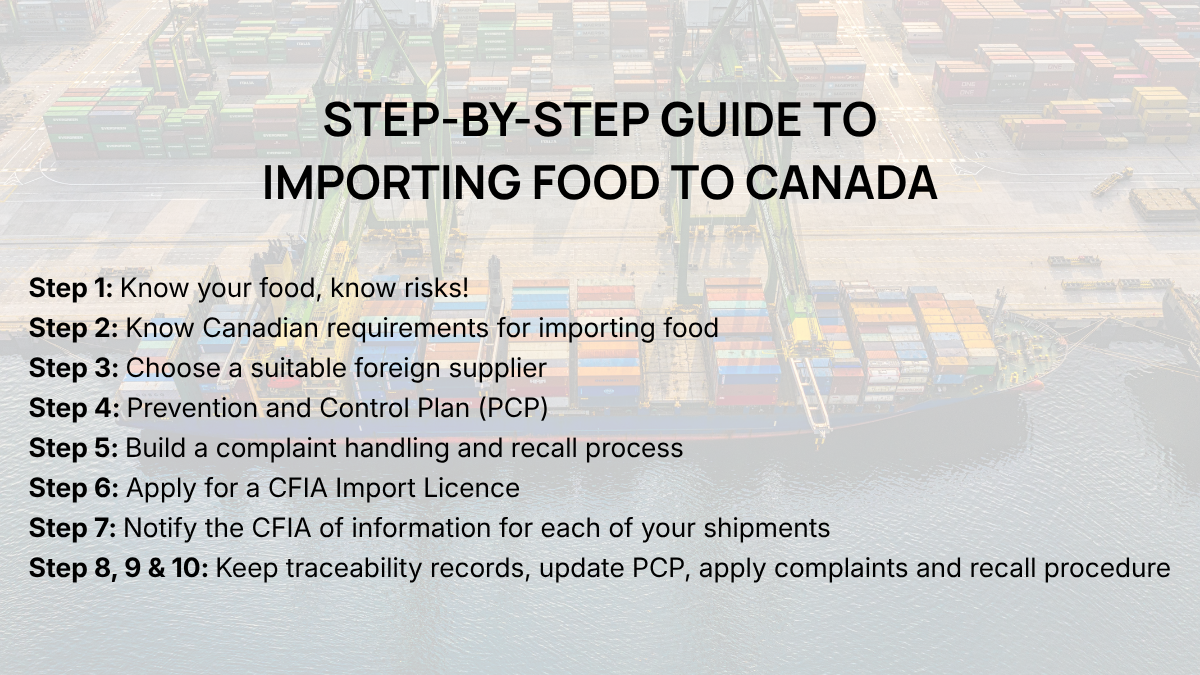
Step 1: Know your food, Know risks!
- Understand the food you will import to Canada, which will include:
- Clarify the food you are importing: food type, its common name, quantity, and food packaging.
- Have you assessed the potential hazards associated with the product? Any food may present biological, chemical, or physical hazards that must be prevented, eliminated, or reduced to levels that do not pose a risk to human health. Importers should be able to demonstrate how these hazards are effectively controlled, typically through a Preventive Control Plan (PCP).
- Do you understand the food supply chains? Also consider:
- Is the food sent directly from the manufacturer?
- Processing, packaging, or labeling by another company or in another country before arriving in Canada.
- Work with foreign suppliers to ensure you know the food’s supply chain, all food safety hazards are identified and controlled, and any additional processing or labeling after coming to Canada, the food is manufactured, prepared, stored, packaged, and labeled under conditions that provide a level of protection equivalent to the requirements of Canada’s Safe Food for Canadians Regulations (SFCR).
Step 2: Know Canadian requirements for importing food
- Food requirements:
- Food has to meet general food safety requirements for its manufacturing, preparation, storage, packaging, labeling, and sanitary conditions.
- In some cases, the food also needs to meet additional regulations: Food and Drug Regulations, Health of Animals Regulations, or Plant Protection Regulations, as well as commodity-specific import rules.
- Importer requirements:
- Key requirements for importers:
- Maintain a PCP
- Establish recall and complaint procedures
- Obtain import licence;
- Ensure food is produced under conditions equivalent to Canadian standards; and
- Keep traceability records for suppliers and customers.
- Procedure Requirements:
- Know the procedures to import into Canada.
Step 3: Choose a suitable foreign supplier
- To import food, meet the required conditions and regulations of Canada
- Remember: meat and shellfish must come from CFIA-approved countries and establishments.
Step 4: Prevention and Control Plan (PCP):
- Must have a preventive and control plan based on the Codex Alimentarius General Principles of Food Hygiene.
- PCPs are one of the requirements of the import license.
Step 5: Build a complaint handling and recall process.
- A process for handling complaints, addressing emerging problems, and recalling when an issue arises.
Step 6: Apply for a CFIA Import Licence
- Before each shipment enters Canada, provide the required shipment information, including your CFIA import licence number, to the CFIA and CBSA.
Start your first shipment!
Step 7: Notify the CFIA of information for each of your shipments:
Provide all information on shipments imported into Canada to the Canada Border Service Agency (CBSA) and the Canadian Food Inspection Agency (CFIA).
After imported completely
Step 8, 9 & 10: Keep traceability records, update PCP, apply complaints and recall procedure:
The measures include maintaining traceability records for imported food, updating the PCP, and implementing complaints and recall procedures to take action.
Source: Government of Canada (n.d.).
Contact Platform Expand and start your food shipments to Canada and the world!